The most diverse sexual orientation.
- Some of us enjoy sexual activities, some don't.
- Some of us have a partner, some prefer to be alone.
- Some of us still find people attractive.
Despite the wide range of differences between us, we have one thing in common: we experience little to no sexual attraction.

~1%
of the population are asexual
1897
When "asexuality" was first defined
♠ (ace)
A symbol of asexuality



Sexual Attraction and the Asexual Spectrum
Sexual attraction is the magnetic pull or longing one person feels toward another, often marked by a desire for physical intimacy and connection. But on the asexual spectrum, people might rarely feel this pull or not at all. This highlights the wide variation in how people experience sexual attraction.

Asexual
Asexual (or ace for short) refers to people who do not experience sexual attraction toward others.
We also use it as a general term to refer to anyone on the spectrum.
Graysexual
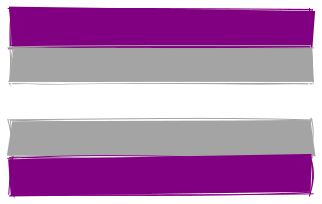
A graysexual individual very rarely experience sexual attraction, experience it at a low intensity, or feel it only under specific circumstances.

Demisexual
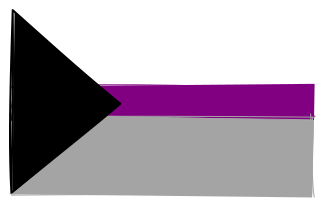
A demisexual person does not experience sexual attraction until they have formed a strong emotional connection with a prospective partner.
Fraysexual
Someone who is fraysexual may be sexually attracted to another person initially, but their attraction fades over time once they develop an emotional bond.
And more identities under the ace umbrella such as aceflux, lithosexual, and reciprosexual.

Asexuality within the Split Attraction Model
The Split Attraction Model (SAM) is a model in psychology that distinguishes between a person's sexual, romantic, and tertiary (non-rose) attraction.
Thanks to the SAM, we have a way to explain why asexuals can still experience attraction.
With romantic attraction
An asexual is:
- - a heteroromantic asexual if they are romantically attracted to a different gender;*
- - a homoromantic asexual if they are romantically attracted to the same gender;
- - a biromantic asexual if they are romantically attracted to more than one gender.
With no other types of attraction
If an asexual is not romantically attracted to other people, they are called an aromantic asexual, or aroace.
With tertiary attraction only
An aroace is called an oriented aroace if they experience tertiary attraction, which consists of many types, such as:
- - platonic attraction: the desire for a friendship with someone without any romantic or sexual intentions.
- - alterous attraction: the desire for emotional closeness with a person that is neither platonic or romantic in nature.
- - aesthetic attraction: an appreciation or admiration for someone's appearance, style, or beauty.
- - sensual attraction: the desire to engage in sensual acts with someone in a non-sexual way, such as hugging or cuddling.
* While "heterosexual" traditionally implies attraction to the "opposite sex" (often a binary view), a more inclusive definition refers to attraction to a different gender than one's own.
Asexuals and Attitudes toward Sex
Personal attitudes toward sex (also called sex stances) describe an individual's personal feelings, stance, or attitude toward engaging in sexual interaction themselves.
Asexuality is about attraction; your sex attitude defines personal comfort with sex. They're distinct, so asexual people can feel differently about having sex.
Below are some common sex stances.
Sex-averse
One feels uninterested in or avoids sexual interaction, but without strong negative feelings.
Ideological attitudes toward sex (also known as political sexual opinions) describe an individual's broader ideological or societal stance towards sex in general, often concerning other people's sexuality and its place in society.
These attitudes influence how one views sexual expression, education, and policies in public life, and are also distinct from a person's sexual orientation like asexuality.
Below are the main types of these attitudes.
Sex-positive
Views consensual sex as inherently good and beneficial for individuals and society, supporting freedom in safe sexual expression.
Sex-neutral
Is generally indifferent to sex in broader society, holding no strong positive or negative feelings about it.
Sex-negative
Believes sex is inherently negative, causes societal harm, and should be highly limited or suppressed in society.
The Ace Approaches to Relationships
Asexuality doesn't mean no love life. Aces are capable of love, just like anyone else. From classic couples to platonic soulmates, there's a whole range of relationships out there for us.
Traditional Relationships
Traditional sexual and romantic relationships can work well for some asexuals. They may choose to participate in sexual activities to meet a partner's needs, while others may focus on emotional and romantic connections. In any case, open communication about boundaries and desires is crucial.
Non-traditional Relationships
Many asexuals, who often identify as part of the broader queer community, are open to exploring alternative relationship structures. This might include unconventional arrangements such as open relationships, non-sexual partnerships, or polyamorous setups.
Queerplatonic Relationships (QPR)
Queerplatonic relationships are a non-traditional relationship model that has gained popularity within asexual and aromantic circles.
A queerplatonic relationship differs from a close friendship by having the same explicit commitment, status, and structure as a formal romantic relationship, whilst it differs from a romantic relationship by not involving feelings of romantic love.
Flying Solo
Not all (asexual) people desire an intimate relationship. Some individuals find fulfillment in platonic connections, friendships, or simply focusing on personal growth and independence.
Voices from the community
Hear our stories, experiences, and perspectives. Learn how we navigate life being the 'invisible' sexual orientation.
pepsigoddess
Posted September 15, 2014
I just want to start by saying hello and thank-you to everyone on these forums. I've just very, VERY recently started personally identifying myself as asexual (only to myself so far though I plan to come out to some very important people to me soon). Before then, it was a lot of worrying, questioning, and uncertainty about my sexuality. Finding AVEN, reading the FAQ, reading other people's stories... these things have been so encouraging to me in so many ways. I literally cried tears of joy when I found this site because I felt like it was just a community of a whole bunch of people like me. Finally I feel like I have a place I fit in and can start to understand myself better. So thank-you a million times. [...]
View original postComment
byu/cat__boy from discussion
inasexuality
Comment
byu/ballsdeep1619 from discussion
inasexuality
Our unique subculture
Asexuality is more than just a label; it is also a movement that has fostered a fun, unique subculture with its own vibes and quirks.

Our colors of pride
They are on the asexual pride flag: black stands for asexuality, gray for the gray-area spectrum, white for allies, and purple for community unity. These colors come together to celebrate who we are and the awesome support we give each other!
Read more
Ace ring: a subtle token of asexuality
The ace ring ⭕, typically worn on the middle finger of the right hand, is a low-key way for someone to show that they are asexual. It started as a plain black ring, but now people may choose different designs to fit their personal styles while still keeping it discreet.
Read more
The ace playing card symbols
Ace cards have become meaningful icons within the aspec community, drawing from the term "ace," a phonetic shortening of asexual. Sometimes, the ace of spades ♠️ is used as an umbrella symbol for asexuality, but it actually represents aromantic asexuality, while other suits ♥️♣️♦️ denote other identities within the spectrum.
Read more
Sex is great, but have you tried cake?
This in-joke is a playful way to say that while sex might be great for some, things like cake and garlic bread can be just as awesome. Different pleasures for different folks!
Read moreBecoming more visible
Asexuals often have to deal with allonormativity—the assumption that everyone experiences sexual and romantic attraction—and acephobia—the discrimination against asexual people. We want to challenge these ideas and work toward a more accepting world for everyone. Asexuality projects are a key part of our efforts to achieve this goal.
The Asexual Visibility and Education Network (AVEN)
Founded in 2001 by David Jay, AVEN is the most prolific and well-known asexual community. It serves simultaneously as an informational platform, a space for fostering community, and as a forum for facilitating discussion.
Visit website
AsexualityArchive
The Asexuality Archive was created to centralize and preserve valuable information about asexuality, which is often scattered across blogs and forums. Its goal is to ensure that important content remains accessible and organized over time.
Visit website
The Asexuality Handbook
The Asexuality Handbook originated from the r/asexuality subreddit wiki. This site serves as a comprehensive resource on asexuality, offering detailed information and guidance for those exploring or learning about the topic.
Visit website




Frequently Asked Questions
-
No. Asexuality is an inherent sexual orientation - a lack of sexual attraction to others. Celibacy or abstinence, however, are choices to refrain from sexual activity, often for personal or other reasons.
-
Nope. Asexuality is a perfectly valid sexual orientation, not a medical condition, illness, or something that needs to be "fixed." Major LGBTQ+ organizations and mental health professionals recognize it as a natural variation of human sexuality.
-
No. Again, asexuality is a sexual orientation. Low libido is about a reduced desire for sexual activity, which can affect anyone, regardless of their orientation. An asexual person can have any level of libido.
-
Yes, many are! Asexual people are generally considered part of the broader queer/LGBTQIA+ community as asexuality falls outside "typical" attraction and often involves navigating similar challenges. The "A" in LGBTQIA+ frequently stands for asexual (and aromantic/agender). However, not all asexual people identify with the LGBTQIA+ community, which is entirely valid; identity is personal.
-
The best way to be supportive is to listen, believe them, and respect their identity. Educate yourself, avoid making assumptions, and don't try to "fix" or "cure" them. Understand that their asexuality is a valid and intrinsic part of who they are.